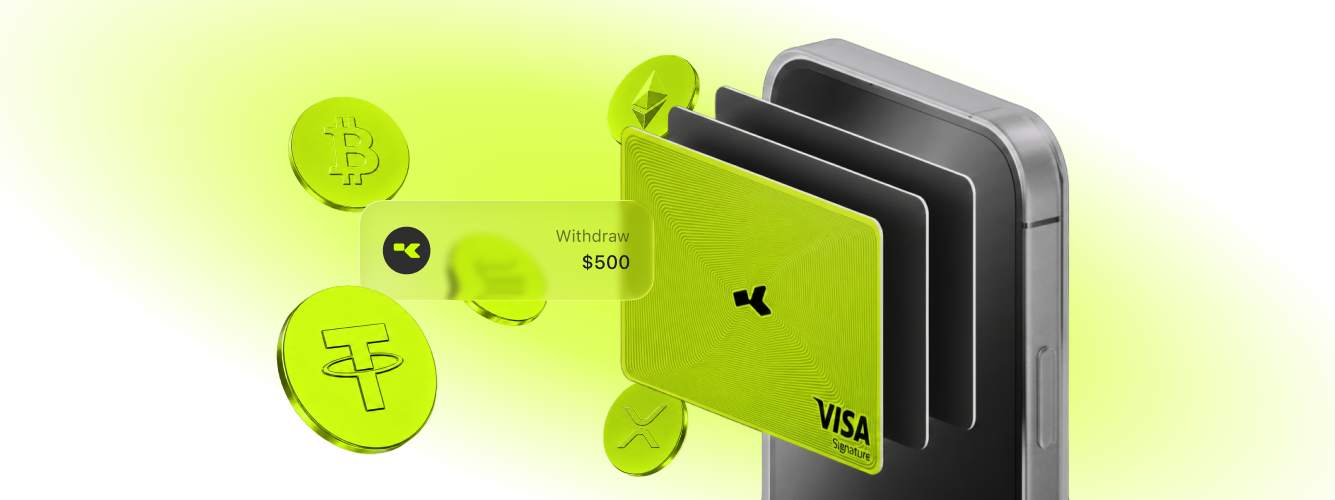
Withdraw USDT to Bank Card in UAE: Cash-Out vs Crypto Card


Getting paid in USDT is easy. Using it in everyday life is where many UAE users get stuck.
Rent, subscriptions, suppliers, travel, ad accounts, software, invoices, and daily payments still mostly run through banks, cards, and fiat currencies such as AED, USD, or EUR. That is why many people search for the same thing: how to withdraw USDT to a bank card in the UAE.
But the wording is not quite accurate.
You do not withdraw USDT directly to a bank card in the same way you send money to a bank account. USDT is a blockchain asset. Bank accounts and card networks do not receive TRC-20, ERC-20, Polygon, Base, Arbitrum, Solana, or other token transfers as card money.
In practice, there are two main ways to make USDT usable in the UAE:
- Top up a crypto-funded card with USDT or USDC, then spend through Visa.
- Sell USDT for fiat, then withdraw AED or USD to a bank account.
Both routes can work. The right choice depends on what you need next.
If your goal is to pay online, travel, cover subscriptions, or spend stablecoins without repeating a manual cash-out every time, Karta is built for that.
If you need AED in a UAE bank account, use a bank withdrawal route.
Get Karta and turn USDT or USDC into a Visa balance you can actually use.
The Short Answer
If your final goal is payment, a bank withdrawal may be an unnecessary extra step. With Karta, you top up your account with USDT or USDC, activate a Visa card, and use your stablecoin-funded balance for eligible card payments.
You are not withdrawing USDT directly to a card in the literal blockchain sense. You are turning stablecoins into spendable card balance.
That distinction matters. It helps you avoid failed withdrawals, unnecessary bank steps, and repeated exchange-to-bank cash-outs.
If you need fiat in your UAE bank account, a locally licensed exchange route with AED withdrawals is usually the most direct option for eligible users.
Binance Dubai supports direct AED deposits and withdrawals for UAE users, with 0 AED deposit fees and a fixed 10 AED withdrawal fee listed in its June 2026 announcement. Binance FZE is also listed in VARA’s public register as an active VASP licence holder.
OKX also supports AED bank withdrawals. Its AED withdrawal help page lists a 35 AED bank-transfer withdrawal fee, a 200 AED minimum withdrawal amount including the fee, and processing times of up to 3 business days for withdrawals of 50,000 AED or less, or up to 5 business days for larger withdrawals. OKX Middle East Fintech FZE is also listed in VARA’s public register as an active VASP licence holder.
But often, “withdraw USDT to card” really means something simpler: users want to spend their stablecoins on SaaS tools, ad accounts, business travel, online services, subscriptions, software, and everyday expenses.
That is where Karta fits.
Can You Withdraw USDT Directly to a UAE Bank Card?
Not directly.
A bank card is connected to fiat payment rails. USDT lives on blockchain networks. For a card payment to happen, something in the middle has to convert, settle, or spend value through a payment provider.
So when users say “withdraw USDT to card,” they usually mean one of these outcomes:
| Need | Use | Why |
|---|---|---|
| Regular card payments | Karta | Spend from a stablecoin-funded balance |
| SaaS, ads, tools, and subscriptions | Karta | Avoid repeated cash-outs |
| Business travel and online payments | Karta | Visa-based payment flow |
| AED in a UAE bank account | Exchange withdrawal | Direct fiat settlement |
| One-off local AED sale | P2P | Flexible, but counterparty risk applies |
| Large crypto-to-fiat conversion | Exchange or OTC desk | Better suited for high-volume execution |
| Clean business records | Exchange or Karta | Easier to document than informal transfers |
The real question is not always: “How do I withdraw USDT?”
For many users, the better question is: “How do I make my USDT usable?”
That is the problem Karta is designed to solve.
Option 1: Use Karta to Spend USDT or USDC Through Visa
This is the route for users who do not want to cash out manually every time they need to pay.
Karta is built for people who already hold USDT or USDC and want to use those funds without sending them through an exchange and bank account first. You top up your Karta balance, activate a Visa card, and spend on card-based payments such as subscriptions, travel, ads, software, online tools, and everyday expenses.
The flow is short:
USDT or USDC → Karta balance → Visa payment
Instead of:
USDT → exchange → AED/USD → bank account → bank card → payment
That is the core benefit: fewer steps between receiving stablecoins and actually using them.
Its public fees section currently lists a 5 USDT virtual Visa activation fee and 1.5% card payments. Crypto top-ups are free on most supported networks, while Tron top-ups carry a 5.90 USDT fee and a 15 USDT minimum top-up amount.
For ATM withdrawals, Karta lists 1 USDT + 2.5% for successful withdrawals, and 1 USDT for declined ATM withdrawals.
Karta is not the same as withdrawing AED to a bank account. It solves a different problem: making stablecoins usable for payments.
For example, if you receive USDT from international clients and need to pay for cloud services, ad accounts, business travel, software, or subscriptions, Karta can be faster than moving funds through an exchange, waiting for a bank withdrawal, and then paying with a bank card.
Get Karta and spend stablecoins through Visa without the usual exchange-to-bank detour.
Option 2: Withdraw USDT to a UAE Bank Account Through an Exchange
Use this route when your goal is to receive AED or USD inside a bank account.
The typical workflow is simple:
- Deposit USDT into an exchange account.
- Convert or sell USDT into AED or another supported fiat currency.
- Add and verify your bank account.
- Request a fiat withdrawal.
- Keep your trade, withdrawal, and bank records.
This method is useful when you need bank-settled money for rent, payroll, supplier invoices, savings, or transfers that require a named bank account.
Binance Dubai
For eligible UAE users, Binance Dubai supports direct AED deposits and withdrawals.
The practical route is:
USDT → AED conversion → AED withdrawal to verified UAE bank account
Binance currently lists 0 AED deposit fees and a fixed 10 AED withdrawal fee for direct AED bank transfers between a UAE bank account and Binance Dubai.
This can be a strong option when you specifically need AED in your bank account rather than card spending.
OKX UAE
OKX also supports AED bank withdrawals for eligible users.
The practical route is similar:
USDT → AED conversion → AED withdrawal to verified UAE bank account
OKX lists a 35 AED fee for AED bank-transfer withdrawals, a 200 AED minimum withdrawal amount including the fee, and processing times of up to 3 business days for withdrawals of 50,000 AED or less, or up to 5 business days for larger withdrawals.
This is a good fit when you want an exchange-led bank withdrawal with clear fiat settlement.
Before using any exchange route, check the final withdrawal preview, supported bank method, KYC status, account eligibility, and current limits.
Option 3: Use P2P to Sell USDT for AED
P2P used to be one of the most common ways to cash out USDT in the UAE.
The idea is simple: you sell USDT to another user, they send AED to your bank account, and the platform releases the crypto once payment is confirmed.
P2P can be fast and flexible. It may also offer competitive rates depending on market demand. But it comes with trade-offs.
You depend on the counterparty, payment timing, sender name matching, transfer references, bank review risk, and the platform’s dispute process.
Banks may also ask questions if you receive repeated transfers from unrelated individuals with unclear references.
P2P can work for occasional local cash-outs if you understand the risks and use proper escrow. For recurring payments, business expenses, and repeatable workflows, it is usually less clean than an exchange withdrawal or a card-based spending setup.
Exchange Withdrawal vs Karta: Which One Should You Use?
Karta is strongest when your real need is not “send AED to my bank account,” but “make my stablecoins usable.”
Use Karta when you need to spend.
Use an exchange when you need a bank-settled fiat.
For many UAE users, the smartest setup is both: Karta for card-based payments, and exchange withdrawals for bank-account needs.
Fees, Limits, and Networks to Check
Do not compare only the visible withdrawal fee. Compare the full cost of the route you are actually using.
Depending on the method, the total cost can include:
- blockchain network fees
- exchange spreads
- fiat withdrawal fees
- card payment fees
- ATM fees
- FX or international transaction fees
- P2P spreads
- service fees from an off-ramp or card provider
A low advertised withdrawal fee does not always mean the cheapest or smoothest route. P2P can have no visible platform fee but a weaker exchange rate. Bank withdrawals can have fixed fees but more steps. Card spending can cost a percentage per transaction but remove the need to cash out manually before every payment.
Before moving funds, check five things:
- fees
- limits
- supported networks
- processing time
- account eligibility
Network choice matters too. USDT exists on multiple blockchains, and sending tokens on the wrong network can lead to delays or loss of funds.
TRC-20 is popular because many users are familiar with it, but the best network is the one supported by both your wallet and the receiving platform, with clear fees shown before confirmation.
Compliance in the UAE: Keep the Flow Clean
The UAE has a developed crypto framework, but that does not make every crypto-to-fiat route equally simple from a banking or documentation perspective.
Dubai’s VARA maintains a public register of Virtual Asset Service Providers. Binance FZE and OKX Middle East Fintech FZE are both listed in VARA’s register as active VASP licence holders.
For users, the practical lesson is simple: verified accounts, clear payment routes, and clean records reduce friction.
Keep records of wallet transaction hashes, exchange trades, fiat withdrawal confirmations, invoices or contracts showing source of funds, bank statements, and card statements for business expenses.
This matters especially for freelancers, agencies, traders, founders, and companies receiving stablecoin payments.
Tax Notes for UAE Users
The UAE does not have personal income tax in the same way many other countries do, but business activity still needs attention.
The UAE Federal Tax Authority states that a natural person is subject to Corporate Tax only if they conduct business or business activity in the UAE and total turnover from that activity exceeds AED 1 million within the calendar year. It also states that wages, personal investment income, and real estate investment income are not considered business or business activity for this purpose.
Private use is different from running a business, agency, trading operation, or professional activity.
If stablecoins are part of your business income, keep records and speak with a qualified tax adviser.
Common Mistakes When Cashing Out USDT in the UAE
The most common mistakes are:
- thinking USDT goes directly to a card
- choosing P2P only because the rate looks better
- ignoring documentation
- sending stablecoins on the wrong network
- assuming all card, bank, and exchange routes work the same way
A better P2P rate is not always better execution. Counterparty risk, delays, disputes, and bank reviews can cost more than the visible spread.
And if you receive regular AED transfers from different people with unclear references, your bank may ask questions.
Final Takeaway
Cashing out USDT in the UAE is not difficult, but the wording can be misleading.
You are usually not withdrawing USDT directly to a bank card. You are either funding a card balance and spending through Visa, or converting USDT into fiat and withdrawing to a bank account.
For everyday spending, subscriptions, travel, online payments, ads, software, and business expenses, Karta offers the shorter workflow:
Top up with USDT or USDC, activate your Visa card, and spend from your stablecoin-funded balance.
For UAE bank withdrawals, exchange routes such as Binance Dubai or OKX are usually the most direct option for eligible users.
Need AED in your bank account? Use a bank withdrawal route.
Want to keep value in stablecoins and spend it like money? Use Karta.
Top up Karta with USDT or USDC, activate your Visa card, and make your stablecoins ready for online payments, travel, subscriptions, and everyday spending.
FAQ
Can I withdraw USDT directly to a UAE bank card?
Not directly. USDT has to be converted, settled, or spent through a card or payment provider. A bank card receives fiat-card transactions, not blockchain tokens.
What is the easiest way to withdraw USDT to a UAE bank account?
For eligible users, a locally licensed exchange route with AED bank withdrawals is usually the simplest route. You sell USDT for AED and withdraw to your verified UAE bank account.
Can I use Binance to withdraw USDT to AED in the UAE?
Eligible Binance Dubai users can use AED deposit and withdrawal rails. The usual flow is USDT to AED conversion, followed by AED withdrawal to a verified UAE bank account. Binance currently lists a fixed 10 AED withdrawal fee for AED withdrawals.
Can I use OKX to withdraw AED in the UAE?
OKX supports AED bank withdrawals for eligible users. Availability depends on verification, account status, supported methods, limits, and the final withdrawal preview. OKX currently lists a 35 AED fee and a 200 AED minimum withdrawal amount for AED bank-transfer withdrawals.
Is P2P safe for selling USDT in Dubai?
P2P can work, but it carries counterparty and bank-transfer risk. Use platform escrow, avoid off-platform deals, check sender names carefully, and keep records.
Is Karta a bank withdrawal service?
Karta is better described as a crypto-funded payment app and Visa card workflow. You can top up with USDT or USDC and spend by card. That is different from withdrawing AED directly to a UAE bank account.
When should I use Karta instead of an exchange?
Use Karta when your final goal is card spending: SaaS, travel, online tools, ads, subscriptions, or everyday Visa payments. Use an exchange when you need fiat settled into a bank account.
What network should I use for USDT transfers?
Use a network supported by both your wallet and the receiving platform. Always check the token, network, address, fee, and confirmation screen before sending funds.
Do UAE users pay tax on USDT withdrawals?
Tax depends on whether the activity is personal or business-related. For business use, keep records and speak with a qualified tax adviser.
What should I check before cashing out USDT?
Check the provider’s live fees, supported networks, withdrawal limits, processing time, KYC status, bank-account rules, and source-of-funds documentation requirements.